JCS Studio

Seu Carrinho (0)

Seu carrinho está vazio.

Subtotal $0.00

Dados da NASA

Imagem Astronómica do Dia

Veja a imagem astronómica da NASA de hoje e até aos oito dias anteriores.

Atualizado em 2026-08-28 10:00:10

O texto da explicação da imagem apresenta-se apenas em inglês pois a fonte é a NASA.

Imagem de hoje e dos sete dias anteriores. Selecione uma miniatura para abrir a imagem em tamanho grande e use os controlos para ampliar.

The Sky Turns Above Paranal

28/08/2026

Explicação: At the latitude of ESO's Paranal Observatory in Chile, about 25 degrees south, Earth's rotation moves the planet's surface eastward at over 1,500 kilometers per hour. And while that's faster than the speed of sound at sea level, the motion is imperceptible. Still, that motion can be revealed in the apparent rotation of the night sky by photographing star trails. This star trail image was composed from a digital stack of 300 consecutive 25-second exposures made with a camera fixed to a tripod to trace the star trail arcs. The graceful arcs are concentric and centered at the south celestial pole, the southern hemisphere extension of Earth's axis of rotation into space. One of the observatory's operating 1.8 meter auxiliary telescopes, AT 3, appears beneath the south celestial pole, faintly illuminated in the foreground of this well-planned scene from a rotating planet. APOD's main NASA site is moving: From apod.nasa.gov to science.nasa.gov/apod

Créditos: Osvaldo Castillo
Colorful Aurora over Icelandic Waterfall

27/08/2026

Explicação: What a sight to behold, when a night sky became filled with colors that appeared to rain over the Skógafoss waterfall in Iceland. This image was taken in a single 5 second exposure by the photographer in April 2025. Seeing an aurora is on many people's bucket lists. But it is not easy. It requires high solar activity, dark and clear skies, and usually a viewing location at high latitude. That makes the northern lights more easily seen than the corresponding southern lights, simply because there is less landmass in the Southern Hemisphere, especially around the Antarctic Circle. Auroras are caused by charged particles from the solar wind that are captured by the Earth's magnetosphere and guided by the magnetic field to a region close to one of the poles, where they collide with gas particles in the atmosphere. Different colors indicate interactions with different gases at different altitudes, like oxygen (red and green) and nitrogen (blue and pink). APOD's main NASA site is moving : From apod.nasa.gov to science.nasa.gov/apod

Créditos: Victor Lima Text: Cecilia Chirenti (NASA GSFC, UMCP, CRESST II)

JWST Images The Lion's Head Nebula

26/08/2026

Explicação: Are we looking at the future of our Sun? The James Webb Space Telescope captured today’s composite image of the Lion’s Head Nebula (NGC 2392) with its NIRCam and MIRI instruments. The Lion’s Head Nebula is the remnant of a Sun-like star. This star was unable to sustain the nuclear fusion in its core needed to remain stable. It began to shed layers of gas and dust into space, forming this planetary nebula. A hot stellar core, called a white dwarf, is left behind within the lion’s nose. Do not boop this nose! Intense radiation from the white dwarf is ionizing the gas as it expands, creating the irregular bubble that makes up the lion’s face. Dust clumps that have survived the white dwarf’s radiation and a cloud of ionized gas make up the lion’s mane. This new and more detailed view of the nebula will help humanity learn more about how the gas and dust interact with each other and the white dwarf radiation.

Earth's Shadow Visualized with Lunar Eclipses

25/08/2026

Explicação: What’s creating this giant hole in space? This is not a black hole — it’s a shadow. It’s Earth’s shadow. Since at least the time of Aristotle, people have noted that Earth's dark shadow on the Moon during a partial lunar eclipse is circular -- although never a whole circle. Using modern digital technology, though, the images of multiple lunar eclipses can be combined to show Earth's complete shadow. The featured image compilation by a perseistent astrophotographer is constructed from 22 years of lunar eclipses. The Moon is not eclipsed every month (moon-th) because the Moon's orbit is slightly tilted relative to Earth's orbit. Close inspection of some lunar eclipse images shows a faint blue band where Earth’s atmosphere filters out more red sunlight than blue. Later this week, a new lunar eclipse will occur and will be best visible in parts of North and South America, Europe, and Africa. APOD's main NASA site is moving : From apod.nasa.gov to science.nasa.gov/apod

Créditos: Tim Martin

Comet 220P in Outburst

24/08/2026

Explicação: Comet 220P is unexpectedly bright. Normally, periodic Comet 220P/McNaught is so dim that to see it requires a telescope. Two surprising outbursts this year, however, have made it about 20,000 times brighter than usual, so that it is now visible with binoculars and long-duration camera exposures. As expected, Comet 220P continues to orbit the Sun between Mars and Jupiter with a period of over 5 years. The featured long duration exposure, taken 10 days ago from South Africa, shows the comet's bright green head and short dust tail. Reasons for Comet 220P's impressive outbursts are unknown but could be caused by the release of built-up subsurface gas or comet quakes. Comet 220P will pass about one Earth-Sun distance from the Earth in October, after which it is expected to fade quickly as it begins its return to the far part of its orbit. APOD's main NASA site is moving : From apod.nasa.gov to science.nasa.gov/apod

Créditos: Spilios Asimakopoulos

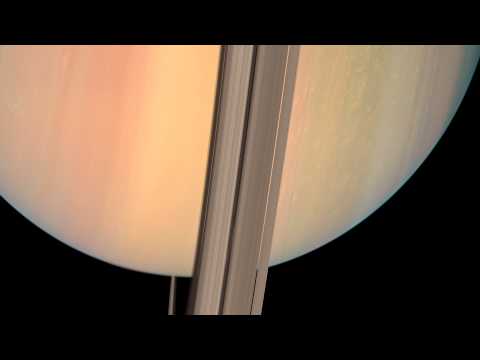
Cassini Approaches Saturn Ver vídeo

Cassini Approaches Saturn

23/08/2026

Explicação: What would it look like to approach the grand planet Saturn? One doesn't have to just imagine -- the Cassini spacecraft did just this in 2004, recording thousands of images along the way, and hundreds of thousands more since entering orbit. Some of Cassini's early images have been digitally tweaked, cropped, and compiled into the featured inspiring video which is part of a larger IMAX movie project named In Saturn's Rings. In the concluding sequence, Saturn looms increasingly large on approach as cloudy Titan swoops below. With Saturn whirling around in the background, Cassini is next depicted flying over Mimas, with large Herschel Crater clearly visible. Saturn's majestic rings then take over the show as Cassini crosses Saturn's thin ring plane. Dark shadows of the ring appear on Saturn itself. Finally, the enigmatic ice-geyser moon Enceladus appears in the distance and then is approached just as the video clip ends. After more than a decade of exploration and discovery, the Cassini spacecraft ran low on fuel in 2017 was directed to enter Saturn's atmosphere, where it surely melted. APOD's main NASA site is moving : From apod.nasa.gov to science.nasa.gov/apod

Créditos: Cassini Imaging Team, ISS, JPL, NASA, ESA, S. Van Vuuren et al.; Music: Adagio for Strings (NY Philharmonic)

Mostly Perseids

22/08/2026

Explicação: Recorded the night of August 12-13, images from four dedicated meteor-monitoring cameras at an astronomical observatory in Czechia were aligned and combined to create this all-night, all-sky view. On that night, the total count came to 1,706 meteors. And since that coincided with the peak activity of the 2026 Perseid Meteor Shower, most are perseids. Their overwhelming numbers make them easy to spot. Quite convincingly, perseid trails all trace back to a single radiant on the sky at the upper right, a region in the annual shower's eponymous constellation Perseus. But meteors belonging to other much less active showers can also revealed by finding their radiants too. For example, seen crossing the perseid trails are meteors from a shower whose radiant lies in Cygnus, known as Kappa Cygnids. The antihelion complex, a general region near Aquarius and opposite the Sun in the sky, is also identifiable as a weak source for meteors.

Créditos: Valašské Meziříčí Observatory

Ver vídeo

Time-Lapse of the Star S301 Orbiting the Black Hole in the Center of the Galaxy

21/08/2026

Explicação: What does it feel like to zoom around a spinning supermassive black hole? The featured video is an animation showing a time-lapse of 4 years of observations of the star S301 orbiting Sagittarius A*, the 4-million-solar-mass black hole in the center of our Galaxy. S301 was discovered in 2023 with the Very Large Telescope Interferometer of the European Southern Observatory, located in the Atacama Desert in Chile. Astronomers recently found that S301 takes approximately 8.7 years to go around the black hole and reaches speeds of 25,000 km/s. It comes closer to the black hole than any other stars detected before, at a distance similar to that from Saturn to the Sun. Because it comes so close to Sagittarius A*, S301 could be used to directly measure how fast the black hole spins and test Einstein's theory of general relativity. According to the theory, a spinning black hole drags the fabric of spacetime around itself, affecting the orbits of close-by objects.

Partilhe este projeto

Envie a ligação a quem possa beneficiar desta informação.